Carbon Fiber Fishing Rods: Modulus, Action & How to Source Custom (vs Fiberglass)
A complete guide to carbon fiber fishing rods — what graphite/carbon blanks are, how modulus and action shape the feel, carbon vs fiberglass vs composite, blank construction, sections and travel rods, and how to source custom or private-label rods factory-direct.
This technical guide was prepared by the MASTERMATE Engineering Team based on our experience in carbon fiber material selection, composite manufacturing, CNC machining and OEM/ODM production.
Walk into any tackle shop and most rods now say "graphite" or "carbon" on the blank — for good reason. Carbon fiber gave anglers rods that are dramatically lighter and more sensitive than the old fiberglass poles, so a finger can feel a fish mouth the bait. But "carbon fiber fishing rod" spans everything from a $30 panfish rod to a $500 tournament stick, and the differences come down to a few specs: modulus, action, power and build quality. This guide explains what actually matters, how carbon compares to fiberglass, and how brands and distributors source custom or private-label rods.
What Is a Carbon Fiber Fishing Rod?
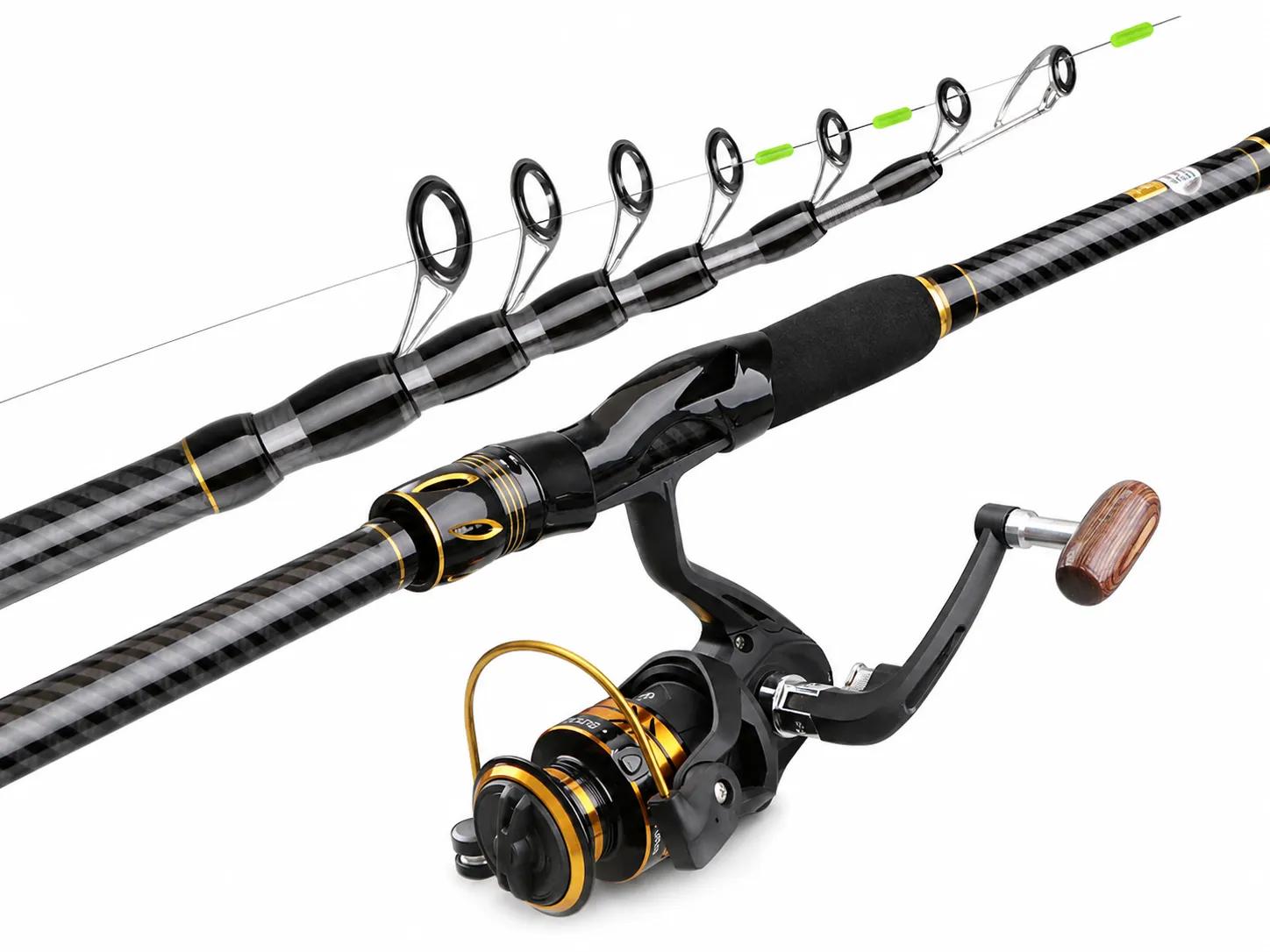
A carbon fiber fishing rod is built around a blank — the tapered tube that does the work — made from carbon-fiber-reinforced polymer (CFRP), commonly called "graphite" in the tackle trade [1]. Carbon prepreg sheet is rolled over a steel mandrel and cured, producing a light, hollow, tapered blank. Everything else is hardware fitted to that blank.
- Blank — the tapered carbon tube; modulus, taper and wall thickness set the feel.
- Guides — the rings the line runs through; stainless or titanium frames with ceramic inserts.
- Reel seat — holds the reel; graphite or aluminum.
- Grip / handle — EVA foam or cork, full-length or split.
Modulus — The Spec That Defines the Blank
Modulus measures the stiffness of the carbon fiber itself — how much it resists bending for a given weight [2]. Higher-modulus fiber lets a maker hit the same stiffness with less material, so the rod gets lighter and more sensitive — but also more brittle and more expensive. It is the single biggest driver of price and feel.
| Modulus | Feel | Trade-off |
|---|---|---|
| Low / standard (~24T) | Tougher, more forgiving | Heavier, less sensitive |
| Mid (~30T, "IM7"-class) | Balanced weight & sensitivity | The popular all-round choice |
| High (40T and up) | Ultra-light, very sensitive | More brittle, higher cost |
Action and Power
Two more specs decide how the rod behaves, and they are independent of modulus [3].
- Action — where the blank bends. Fast (bends near the tip) is sensitive with quick hooksets; moderate/slow (bends deeper) loads smoothly and protects light line.
- Power — how much force it takes to bend the rod: ultralight, light, medium, medium-heavy, heavy. Match it to your lure weight and target species.
- Length — short rods (under 6 ft) give accuracy; long rods (7 ft and up) cast farther and pick up line faster.
- Line & lure rating — printed on the blank; stay within it for best performance and safety.
Carbon vs Fiberglass vs Composite
Blank material is the first fork in the road, and many rods blend both fibers.
| Factor | Carbon / graphite | Fiberglass | Composite |
|---|---|---|---|
| Weight | Lightest | Heaviest | Medium |
| Sensitivity | Very high | Low | Medium-high |
| Durability | Can be brittle | Very tough | Tough |
| Best for | Finesse, bite detection | Trolling, big game, beginners | All-round, crankbaits |
| Price | Higher | Lower | Mid |
Sections, Travel and Telescopic Rods
How the rod breaks down matters for shipping and for the type of angler.
- One-piece — best action and sensitivity; hardest to ship.
- Two-piece — the common compromise; easy to transport with minimal action loss.
- Travel (3-5 piece) — packs into a case for flights and backpacks.
- Telescopic — collapses into the butt; ultra-portable, with a slight action trade-off.
Sourcing Custom & Private-Label Rods Factory-Direct
Buying factory-direct removes distributor markups and unlocks custom modulus, taper, components and branding for tackle brands and distributors. You can order finished rods or bare blanks to build on [1].
- Bare blanks — your modulus, length, action and taper; for rod builders and brands.
- Finished rods — blank plus guides, reel seat and grip assembled to spec.
- Custom spec — length, power, action, guide train, handle (EVA/cork, split/full).
- Private label — your logo, blank print, packaging and branding for resale.
Browse our sports category for carbon fiber rods and gear, or use the custom page to send a spec sheet. New to the material? Start with "What Is Carbon Fiber?".
Frequently Asked Questions
The questions buyers ask most about carbon fiber fishing rods.
Are carbon fiber fishing rods better than fiberglass?
For sensitivity and weight, yes; for toughness, not always. Carbon (graphite) is much lighter and more sensitive, so you feel light bites and cast with less fatigue — ideal for finesse and most freshwater fishing. Fiberglass is heavier but extremely tough and forgiving, which suits trolling, big game and beginners, and it handles treble-hook lures well. Many anglers keep a carbon rod for feel and a glass or composite rod for hard, abusive duty.
What does modulus mean on a fishing rod?
Modulus describes the stiffness of the carbon fiber for its weight. Higher-modulus carbon reaches the same stiffness with less material, so the blank is lighter and more sensitive — but also more brittle and more expensive. Lower modulus is tougher and cheaper. Higher is not automatically better; the right modulus depends on the fishing, and mid-modulus blanks are the popular all-round balance.
What is the difference between action and power?
Action is where the rod bends: fast action bends near the tip for sensitivity and fast hooksets; slower action bends deeper and loads smoothly. Power is how much force it takes to bend the rod (ultralight to heavy) and should match your lure weight and target fish. A rod can be, for example, "medium-heavy power, fast action" — the two specs are independent and chosen together.
Do carbon fiber rods break easily?
Not in normal use. Carbon blanks are strong along their length but vulnerable to point loads and impacts: high-sticking a fish straight overhead, banging the tip on a hard surface, or fishing outside the rod's line/lure rating. Stay within the printed ratings, avoid sharp knocks and nicks, and a carbon rod lasts for years. Very high-modulus rods need a little more care than fiberglass.
What length and power should I choose?
Match it to the fishing. Shorter rods (under 6 ft) give accuracy and leverage in tight spots; 7 ft and up casts farther and picks up line faster. Power should suit your lure weight and species — ultralight or light for panfish and trout, medium for bass, medium-heavy or heavy for pike, saltwater and heavy cover. Tell us your target species and technique and we can recommend a spec.
Can you produce custom or private-label carbon fiber rods?
Yes. We make carbon fiber blanks and finished rods with OEM/ODM and private-label service: your modulus, length, action, power, taper, guide train, reel seat, grip and branding, plus packaging for resale. Bare blanks suit rod builders; finished rods ship ready to sell. Stock specs have low MOQs; fully custom specs are quoted from your sheet. Send length, power, action, modulus and quantity for a quote with MOQ and lead time.
Sources & Further Reading
Need Custom Carbon Fiber Products?
Our engineering team helps brands worldwide develop OEM carbon fiber solutions with low MOQs and rapid prototyping.
Request a Quote Today.