Carbon Fiber vs Aluminum: Weight, Strength & Cost (2026)
Compare CFRP and 6061 aluminum by finished-part weight, stiffness, tooling, volume, heat transfer, and repairability—not fiber datasheet values alone.
This material comparison was prepared by the MASTERMATE Engineering Team for buyers deciding between carbon fiber composite and aluminum on real OEM programs.
Carbon fiber–reinforced polymer (CFRP) and aluminum alloy are the two materials that engineering teams default to when they need stiff, lightweight structures. They look interchangeable on a spec sheet — both are "lightweight metals/composites with high specific strength" — but the moment you start drawing a real part, the cost curves, manufacturing methods, and failure modes pull them apart fast. This guide compiles the data we hand to clients deciding between the two on real production programs.
Based on MASTERMATE’s manufacturing experience, T700 is commonly selected when a project requires a practical balance of strength, stiffness, impact resistance and production cost. Learn more about custom carbon fiber solutions and carbon fiber OEM/ODM manufacturing from the MASTERMATE Engineering Team.
At a Glance: The Numbers That Actually Matter
Read the figures below as an illustrative design comparison, not certified properties of a particular plate. T700S is a fiber designation; a finished laminate also depends on resin, fiber volume, weave, ply orientation, cure and test direction. Toray publishes separate fiber and composite test values, while 6061-T6 is an alloy and temper designation. Request the actual laminate and aluminum mill test reports before sizing a load-bearing part [1][2].
| Property | CFRP (T700S, 3K twill) | 6061-T6 Aluminum | Carbon advantage |
|---|---|---|---|
| Density | 1.55 g/cm³ | 2.70 g/cm³ | ~43% lighter |
| Tensile strength | ~900 MPa (laminate) | 310 MPa | ~2.9× |
| Tensile modulus | ~70 GPa (quasi-iso) | 69 GPa | Comparable |
| Specific stiffness | ~45 GPa·cm³/g | 26 GPa·cm³/g | ~1.7× |
| Coeff. thermal expansion | ~2 × 10⁻⁶ /K | 23 × 10⁻⁶ /K | Far more dimensionally stable |
| Thermal conductivity | 5–7 W/m·K | 167 W/m·K | Aluminum better for heat sinks |
| Electrical conductivity | Slightly conductive (anisotropic) | High | Aluminum better for grounding |
| Recyclability | Limited (thermoset matrix) | Excellent (closed-loop) | Aluminum better |
Weight: Why "40% Lighter" Understates It
On the illustrative densities above, CFRP is about 43% lighter than 6061 aluminum at the same volume. That is not a guaranteed finished-part saving: thickness, layup, joints, inserts, safety factors and load direction can change the required geometry. Compare two designs that meet the same stiffness, strength and durability requirements, then weigh the complete assemblies [3].
Strength and Stiffness: Anisotropy Is the Story
Aluminum is isotropic — it behaves the same in every direction. Carbon fiber composites are not. A unidirectional CFRP laminate is roughly 5× stiffer along the fiber direction than perpendicular to it. For real parts, designers stack plies at 0°, ±45° and 90° to balance stiffness; the resulting "quasi-isotropic" laminate still beats aluminum on weight-normalized stiffness, but you pay for it in design effort and tooling [4].
Cost: Per-Kilogram vs. Per-Part
Aerospace-grade aluminum sheet costs roughly $4–8 per kilogram. Aerospace prepreg from Toray or Hexcel runs $40–90 per kilogram. On material cost alone, aluminum looks like a clear winner. But material is only one term in the equation — tooling, machining, assembly, and finishing all change the answer. CNC-machining a complex aluminum bracket can cost more in machine time than molding the same part in CFRP if volumes are high enough to amortize the mold [5].
| Volume | CNC 6061 Aluminum | Compression-molded CFRP | Break-even direction |
|---|---|---|---|
| 1–10 pieces | $80–140 / part | $220–320 / part (incl. mold) | Aluminum wins clearly |
| 100 pieces | $55–90 / part | $60–95 / part | Roughly equal |
| 1,000 pieces | $40–65 / part | $28–45 / part | CFRP wins clearly |
The bracket figures are illustrative scenarios, not current market quotes or a universal volume break-even. Aluminum anodizing and secondary machining, or CFRP cure, clear-coat, inspection and trimming, can move the result substantially. Ask suppliers to quote the same drawing, annual volume, tolerance, finish and acceptance criteria for both routes.
Corrosion, Fatigue, and Environmental Resistance
Aluminum forms a protective oxide layer in air, but it is vulnerable to galvanic corrosion when paired with dissimilar metals (steel fasteners, copper inserts) and to pitting in salt spray environments. Anodizing helps, but does not eliminate the issue [6].
CFRP does not corrode in the metallurgical sense, but the resin matrix can absorb moisture, UV-degrade if uncoated, and develop galvanic corrosion of any metal in contact with it because carbon is cathodic. The classic failure mode is a CFRP panel bolted to an aluminum frame in a marine environment — the aluminum corrodes around the bolt holes within months. Insulating washers or fiberglass barrier plies fix this.
Manufacturing Routes
The decision between CFRP and aluminum often collapses to: "Do I have a part geometry that suits molding, or one that suits subtractive machining?" The flow below is the high-level decision tree we walk clients through during our first design review.
- 1. Define loadsIdentify primary and secondary load directions, peak loads, fatigue cycles, and operating temperature range.
- 2. Geometry checkHollow shapes, smooth curves, integrated stiffeners → CFRP molding. Tight tolerances on flat features → aluminum CNC.
- 3. Volume sanity checkBelow ~50 parts, machined aluminum or hand-laid CFRP usually wins. Above ~200, look at compression molding, RTM, or extruded aluminum profiles.
- 4. Environmental reviewHigh temps (>180 °C continuous) or heat-dissipation needs → aluminum. Galvanic, EMI, or weight-critical environments → CFRP with proper isolation.
- 5. Prototype bothMake at least one of each in the first round. Real test data beats handbook numbers in 30% of programs.
When to Choose Each Material
Pick CFRP when…
- Weight is the primary KPI (drones, racing, wearables, aerospace)
- You need anisotropic stiffness tuned to a known load path
- The part has compound curves or hollow sections that suit molding
- Production volumes justify a $1k–$15k mold investment
- Low thermal expansion is a feature, not a side-effect (optical benches, satellite structures)
Pick aluminum when…
- Cost per part dominates the decision and volumes are below ~100
- The part needs to dissipate heat (electronics enclosures, power-supply housings)
- Geometry is dominated by tight, flat tolerances best held on a CNC
- You need easy welding, threading, or post-process machining
- End-of-life recyclability is part of your sustainability story
Illustrative Sourcing Scenarios
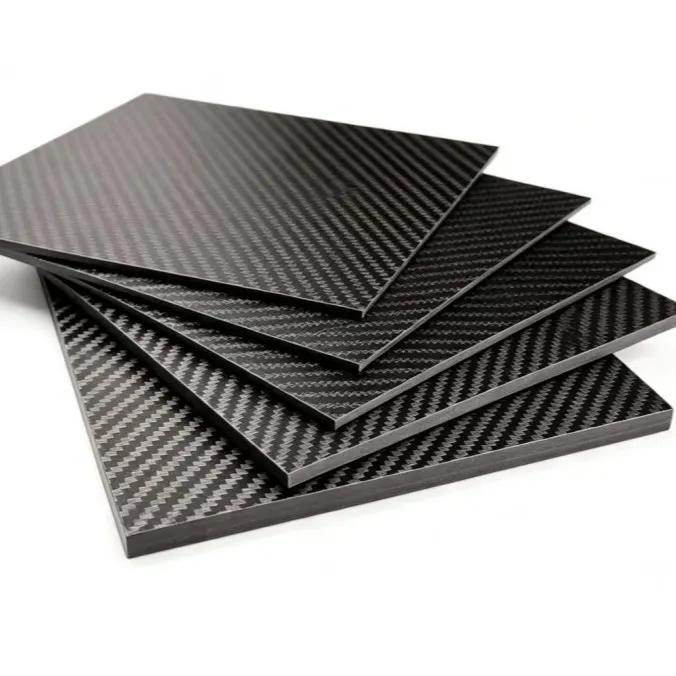
Scenario 1 — FPV drone plate: CFRP is usually the stronger candidate when stiffness per gram and resistance to permanent bending dominate. The actual mass, flight-time, crash-life, and unit-cost result must be validated on the same geometry and production quantity.
Scenario 2 — Low-volume robotics bracket: CNC-machined 6061 often wins when demand is only a few parts per month, because it avoids laminate tooling and supports late drawing changes.
Scenario 3 — Camera or electronics housing: a hybrid design can use aluminum as the heat-spreading structure and a thin CFRP skin for stiffness or appearance. Check galvanic isolation and thermal interfaces before committing to the stack.
Frequently Asked Questions
Quick answers to the questions our sales engineers field most often. The full list is below.
Is carbon fiber actually stronger than aluminum?
On a per-weight basis, yes — carbon fiber composite has roughly 2–3× the specific tensile strength of 6061-T6 aluminum. On absolute strength a thick aluminum block can outperform a thin CFRP laminate; what matters is how much material you need to carry your load.
Does carbon fiber rust?
No. The carbon itself is chemically inert and the resin matrix is non-metallic. However, carbon is electrically cathodic, so any aluminum or steel in direct contact with CFRP in a wet environment will corrode quickly. Use isolation gaskets or a fiberglass barrier ply at the interface.
Can carbon fiber parts be repaired if they crack?
Cosmetic damage and small cracks can be repaired with resin injection and additional plies, similar to fiberglass repair on boats. Structural CFRP repairs require lab-controlled re-cure and are usually only economical for aerospace components. For consumer parts, replacement is normally cheaper than repair.
Is carbon fiber heat-resistant?
The carbon fibers themselves can survive >2000 °C, but standard epoxy resin softens at 120–180 °C. For high-temperature applications, specify bismaleimide (BMI) or PEEK matrix systems, which hold properties up to 250–300 °C continuously.
Why is carbon fiber so much more expensive than aluminum on a per-kilogram basis?
Aerospace-grade carbon precursor (PAN) is itself expensive, and the carbonization process consumes large amounts of energy. Add prepreg manufacturing, controlled storage, hand layup or automated tape laying, and an autoclave or compression cure, and the supply chain has more steps than rolling and extruding aluminum.
Can I weld carbon fiber like I can weld aluminum?
No. Thermoset CFRP cannot be welded — bonded joints, mechanical fasteners, or co-cured assemblies are the standard joining methods. Thermoplastic carbon (PEEK, PPS matrix) can be induction- or ultrasonic-welded, but those materials are uncommon outside aerospace.
Which material is "greener"?
Aluminum has a mature recycling stream and roughly 5% of the energy footprint of virgin production for recycled aluminum. CFRP recycling exists (pyrolysis, solvolysis) but is still niche. If end-of-life recyclability is a hard requirement in your sustainability reporting, aluminum currently wins.
Sources & Further Reading
- Toray Composite Materials — T700S product datasheet
- ASTM D3039 — Standard Test Method for Tensile Properties of Polymer Matrix Composite Materials
- Hexcel HexPly® Prepreg Selector Guide
- The Aluminum Association — Aluminum Alloys 101
- NIST Material Measurement Laboratory — Property Data
- Wikipedia — Carbon-fiber-reinforced polymer
- Wikipedia — 6061 aluminium alloy
- CompositesWorld — How to choose between carbon fiber and aluminum
- SAE International — Composites in Automotive Applications
- ASM International — ASM Handbook Volume 21: Composites
- ISO 527-4 — Plastics tensile testing for composite materials
- CMH-17 — Composite Materials Handbook
How This Guide Was Prepared
Mechanical and cost figures combine published supplier datasheet ranges (for example Toray T700S prepreg and 6061-T6 aluminum) with typical production scenarios observed in custom manufacturing. Values are indicative — confirm final properties and pricing against your drawings, volume and inspection requirements.
Need Custom Carbon Fiber Products?
Our engineering team helps brands worldwide develop OEM carbon fiber solutions with low MOQs and rapid prototyping.
Request a Quote Today.