Carbon Fiber NFC Card Specifications: Chip Memory, ID-1 Size and RF Testing
An evidence-based specification sheet for carbon fiber NFC cards: NXP NTAG 213/215/216 memory, 13.56 MHz operation, ID-1 dimensions, and practical prototype acceptance tests.
This technical guide was prepared by the MASTERMATE Engineering Team based on our experience in carbon fiber material selection, composite manufacturing, CNC machining and OEM/ODM production.
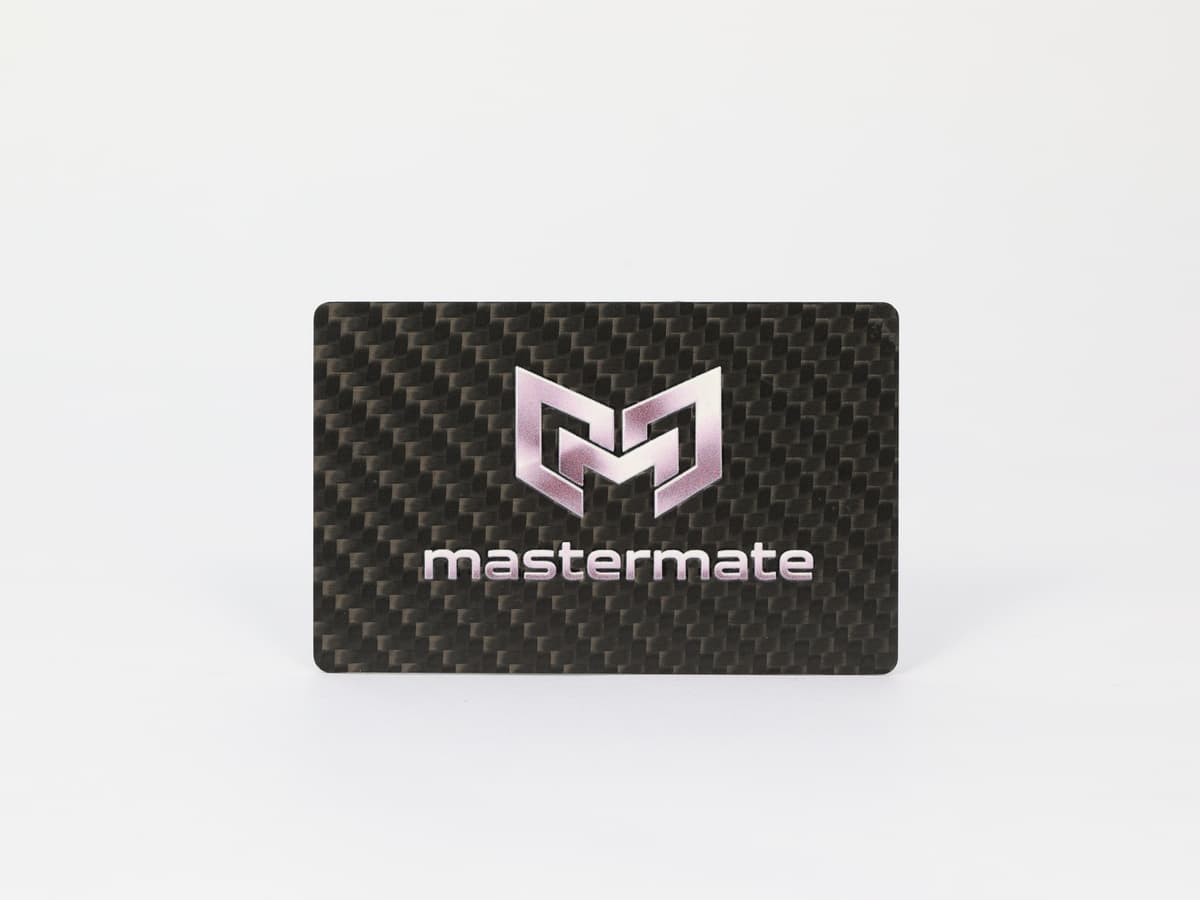
A premium carbon fiber card can look correct and still be frustrating to tap. The useful purchase order therefore separates published component data from measurements on the finished card. This guide gives procurement teams a source-backed starting sheet and an acceptance method. For a broader supplier audit, see our carbon fiber card manufacturer guide.
1. Select the chip by user memory, not its model number alone
NXP identifies NTAG 213, 215 and 216 as NFC Forum Type 2 Tag ICs compatible with ISO/IEC 14443 Type A. Its published freely available user read/write area is 144, 504 and 888 bytes respectively. NXP also lists larger total memory figures of 180, 540 and 924 bytes; total memory must not be quoted as space available for your message [1].
| Chip | User memory | User pages (4 bytes each) | Use in the brief |
|---|---|---|---|
| NTAG 213 | 144 bytes | 36 | Short URL or other small NDEF record, after encoding-size check |
| NTAG 215 | 504 bytes | 126 | Larger NDEF payload when the encoded record exceeds 213 capacity |
| NTAG 216 | 888 bytes | 222 | Largest user-memory option in this three-chip family |
Measure the encoded NDEF record, including its formatting overhead, before locking the chip choice. A URL that fits in a spreadsheet cell is not proof it fits after encoding. If the card only stores a link to an online profile, specify who owns that URL and how its destination will be maintained; chip endurance says nothing about whether the web page will remain available.
2. Treat frequency, speed and endurance as chip specifications
| Parameter | Published figure | What the buyer must still verify |
|---|---|---|
| Operating frequency | 13.56 MHz | Actual phone/reader compatibility in the final card |
| Data transfer rate | 106 kbit/s | Successful reading of the chosen NDEF payload |
| IC data retention | 10 years | Card construction and online destination life are separate |
| IC write endurance | 100,000 cycles | Finished-card handling and laminate durability are separate |
| Operating distance | Up to 100 mm, parameter-dependent | Real distance with specified readers and finished laminate |
NXP explicitly conditions its “up to 100 mm” distance on factors such as field strength and antenna geometry [1]. It is a ceiling in a chip specification, not a carbon-card range claim. Likewise, 10-year retention and 100,000 write cycles describe the IC under its specification; they do not establish a 10-year service life for a card carried in a wallet.
3. Write down the card dimensions and conformance target
ISO’s publicly accessible summary for ISO/IEC 7810:2003 gives ID-1 nominal dimensions of 85.60 × 53.98 mm and nominal thickness of 0.76 mm [2]. ISO marks that edition as withdrawn and points to ISO/IEC 7810:2019 as the current replacement [3]. Use the figures as a familiar design reference, then check the current edition and its tolerances if a buyer requires an ISO conformity statement. A thicker decorative carbon card should be specified by its actual thickness, without an unsupported compliance claim.
4. Validate the antenna inside the real carbon construction
NXP’s antenna guidance explains that nearby conductive metal can change NFC antenna behaviour and that ferrite-backed designs can help in some layouts [4]. Applying that guidance to a particular carbon-fiber laminate is an engineering inference, not a measured result for every card: fiber architecture, resin, layer orientation, antenna position and reader all matter. Ask the manufacturer for an antenna/laminate cross-section and a production-intent sample. Do not assume a bare inlay test predicts the finished-card result.
- Specify the exact chip and antenna/inlay part, not only “NFC compatible.”
- Record card width, height, finished thickness, edge finish and any metal decoration.
- Encode the final NDEF payload and confirm its byte count before production.
- Test the final laminate on named phone and reader models, from both card faces and across likely tap positions.
- Record attempted reads, successful reads, orientation, case/accessory state and observed distance for every sample; agree pass criteria in the purchase order.
- After abrasion or bend testing, repeat the same read protocol and inspect edge/laminate damage.
Copy this into the RFQ
“Please quote a production-intent carbon fiber NFC card with [chip model], [encoded NDEF payload and byte count], [finished width × height × thickness], [surface/edge finish] and [quantity]. Provide the antenna/laminate construction, sample photos and tap-test log on [named devices]. State the agreed read-test method and acceptance threshold separately from the chip manufacturer’s published specifications.”
This separates the decisions a buyer controls from the component facts already published by NXP and ISO. Once samples pass, retain one approved card and its test log as the reference for repeat production. Browse carbon fiber card products for format ideas; the approved specification should still be written for your specific program.
How much user memory do NTAG 213, 215 and 216 provide?
NXP specifies 144, 504 and 888 bytes of freely available user memory respectively. Check the size of the encoded NDEF record before choosing a chip [1].
Will every carbon fiber NFC card read from 100 mm away?
No. NXP lists up to 100 mm for the IC and qualifies the distance by field strength, antenna geometry and other parameters. Finished-card distance must be measured with the intended reader and laminate [1].
Is a 0.76 mm carbon fiber card automatically ISO/IEC 7810 compliant?
No. The 0.76 mm nominal figure appears in ISO’s withdrawn 2003 edition; conformance requires checking all applicable requirements and tolerances in the current 2019 edition [2][3].
Sources & Further Reading
- [1] NXP Semiconductors — NTAG 213/215/216 product specifications (user memory, frequency, speed, range conditions, retention and endurance)
- [2] ISO — ISO/IEC 7810:2003 public summary (withdrawn edition; ID-1 nominal size)
- [3] ISO — ISO/IEC 7810:2019 current edition
- [4] NXP Semiconductors — NFC Antenna Design Made Easy (conductive/metal proximity and ferrite options)
How This Guide Was Prepared
Numerical chip specifications are from NXP. The ID-1 dimensions cited here are from ISO’s publicly accessible 2003 edition, which ISO marks as withdrawn and replaced by the 2019 edition. The RF test plan is an engineering recommendation, not a reported laboratory result or a certification claim.
Need Custom Carbon Fiber Products?
Our engineering team helps brands worldwide develop OEM carbon fiber solutions with low MOQs and rapid prototyping.
Request a Quote Today.