Carbon Fiber Pool Cues: Why They Win, Shaft Tech & How to Buy (vs Maple)
A complete guide to carbon fiber pool cues — why players switch from maple, low-deflection shaft tech, stiffness and consistency, tip and joint options, carbon vs maple shafts, what to look for, and how to source custom or private-label cues factory-direct.
This technical guide was prepared by the MASTERMATE Engineering Team based on our experience in carbon fiber material selection, composite manufacturing, CNC machining and OEM/ODM production.
Carbon fiber shafts have taken over the cue sports world in just a few years — from pro tables to weekend leagues. The reason is simple: wood is never identical twice, and it warps; carbon fiber plays the same every single shot and lasts. But "carbon fiber pool cue" covers everything from a $150 shaft to a $600 full cue, so it helps to understand what carbon actually changes, what specs matter, and how to source them if you are a brand or distributor.
What Is a Carbon Fiber Pool Cue?
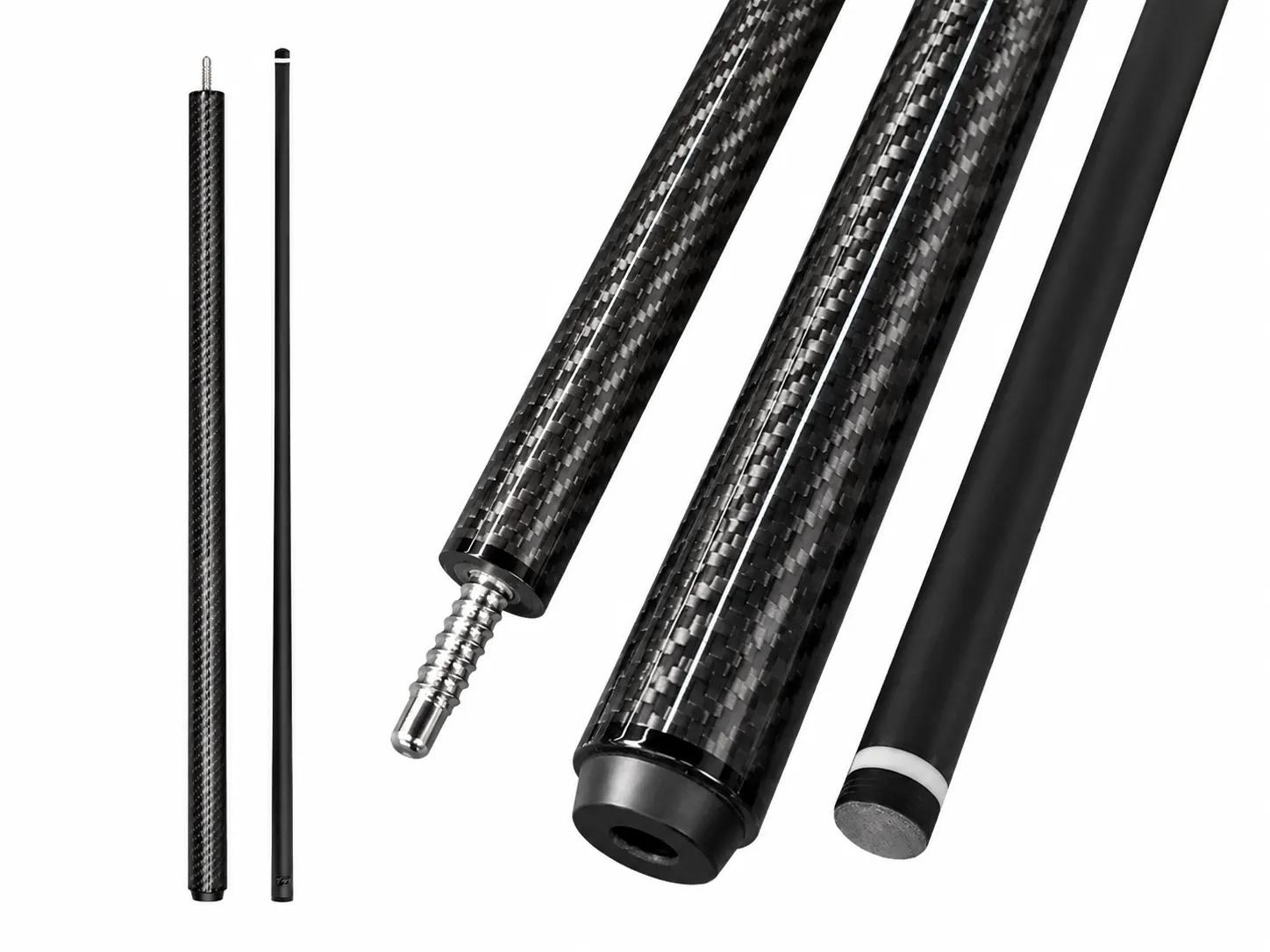
A carbon fiber pool cue uses a carbon-fiber-reinforced polymer (CFRP) shaft — and sometimes butt — in place of maple [1]. Most players buy a carbon shaft to fit their existing butt, since the shaft is where the performance lives.
- Shaft — the carbon composite playing end; this is the main upgrade.
- Butt — often still wood or composite; can also be carbon-wrapped.
- Tip — leather (soft/medium/hard) bonded to the carbon ferrule.
- Joint — connects shaft and butt: 3/8x10, radial, Uni-Loc / quick-release.
Why Players Switch from Maple
Carbon wins on consistency and durability — the two things wood cannot guarantee. The look and weight are secondary [2].
| Factor | Carbon fiber | Maple (wood) |
|---|---|---|
| Consistency | Identical every shaft | Varies piece to piece |
| Deflection (squirt) | Low (more forgiving) | Higher unless tapered |
| Warping | Will not warp | Can warp over time |
| Maintenance | Wipe clean, no sealing | Needs burnishing/sealing |
| Feel / sound | Stiffer, "tighter" hit | Traditional, softer |
| Price | Higher | Lower (entry) |
Specs That Matter: Diameter, Tip, Joint
- Shaft diameter — 12.5 mm (closer to traditional), 11.8 mm (popular modern), down to ~11.5 mm for more spin feel.
- Tip — 14 mm leather, soft for grip/spin or hard for control; replaceable.
- Joint — 3/8x10 and radial are common; quick-release (Uni-Loc style) for fast assembly.
- Weight & balance — typically 3.5-4.0 oz shaft; butt weight tunes total balance.
- Finish — matte or gloss clear coat; some add a grippy or smooth playing surface.
How to Choose (and Common Myths)
- Match the joint to your butt (or buy a full cue) — the wrong joint will not fit.
- Pick diameter by feel: 11.8 mm is the popular all-round choice; 12.5 mm if you want it closer to wood.
- Choose tip hardness for your game: softer for spin, harder for break/control.
- Decide shaft-only (fits your butt) vs full cue.
Sourcing Custom & Private-Label Cues Factory-Direct
Buying factory-direct removes distributor markups and unlocks custom diameters, joints, finishes and branding for cue brands and distributors. The economics depend on whether you want stock shafts or a fully custom spec [3].
- Stock shafts (common diameters + joints) — low MOQ, fastest lead time.
- Custom spec — your diameter, taper, joint, tip and weight; send a spec sheet.
- Private label — your logo, ring work, packaging and branding for resale.
- Full cues — carbon shaft + matched butt as a complete product.
Browse our sports category for carbon fiber cues, paddles and gear, or use the custom page to send a spec. New to the material? Start with "What Is Carbon Fiber?".
Frequently Asked Questions
The questions buyers ask most about carbon fiber pool cues.
Are carbon fiber pool cues better than wood?
For most players, yes on consistency and durability. A carbon fiber shaft plays the same every shot, has low deflection that makes aiming more forgiving, will not warp, and needs almost no maintenance. Wood has a traditional feel some players prefer and is cheaper at entry level, but it varies piece to piece and can warp. If you value consistency and low maintenance, carbon is the upgrade; if you love the classic feel and budget, wood still has a place.
What does low deflection (squirt) mean on a carbon cue?
Deflection, or "squirt", is how much the cue ball veers off your aim line when you hit off-center to apply spin. A low-deflection carbon shaft bends less on impact, so the ball travels closer to where you aimed — making spin and position shots more predictable. Low deflection is the single biggest reason players switch to carbon shafts.
What shaft diameter should I choose?
It is mostly feel. 12.5 mm plays closest to a traditional maple shaft; 11.8 mm is the popular modern all-round size; around 11.5 mm gives an even slimmer feel that some players prefer for spin. There is no single "best" — pick by what feels comfortable in your bridge. We can produce the diameter and taper you want.
Will a carbon fiber shaft fit my existing cue butt?
Only if the joint matches. Common joints are 3/8x10, radial and quick-release (Uni-Loc style). Buy a shaft with the same joint as your butt, or buy a full cue. If you are unsure, tell us your butt brand/joint and we will confirm compatibility or supply a matched full cue.
Do carbon fiber pool cues need maintenance?
Very little. Unlike maple, a carbon shaft does not need burnishing or sealing and will not warp. Just wipe it clean with a dry or slightly damp cloth; the tip is still leather and is replaced normally as it wears. That low-maintenance, no-warp durability is a major reason carbon has taken over cue sports.
Can you produce custom or private-label carbon fiber cues?
Yes. We make carbon fiber shafts and full cues with OEM/ODM and private-label service: your diameter, taper, joint, tip, weight, finish, ring/wrap work and branding. Stock specs have low MOQs; fully custom specs are quoted from your sheet. Tell us the diameter, joint, tip and quantity for a quote with MOQ and lead time.
Sources & Further Reading
Need Custom Carbon Fiber Products?
Our engineering team helps brands worldwide develop OEM carbon fiber solutions with low MOQs and rapid prototyping.
Request a Quote Today.