Custom Carbon Fiber Parts for Cars: The Complete Aftermarket & OEM Guide
Sourcing custom carbon fiber auto parts — hoods, spoilers, diffusers, mirror caps and interior trim. Real vs forged carbon, OEM vs aftermarket, costs, MOQ and how to order factory-direct.
This technical guide was prepared by the MASTERMATE Engineering Team based on our experience in carbon fiber material selection, composite manufacturing, CNC machining and OEM/ODM production.
Carbon fiber went from an exotic Formula 1 material to the single most popular car upgrade in under two decades. Today buyers order everything from full carbon fiber body kits down to a set of mirror caps. But "carbon fiber car parts" hides an enormous range of quality, construction and price — and most of the disappointment in this market comes from not knowing which one you are buying. This guide is the same briefing we give buyers sourcing custom and aftermarket carbon fiber auto parts from our factory.
Why Carbon Fiber for Car Parts at All
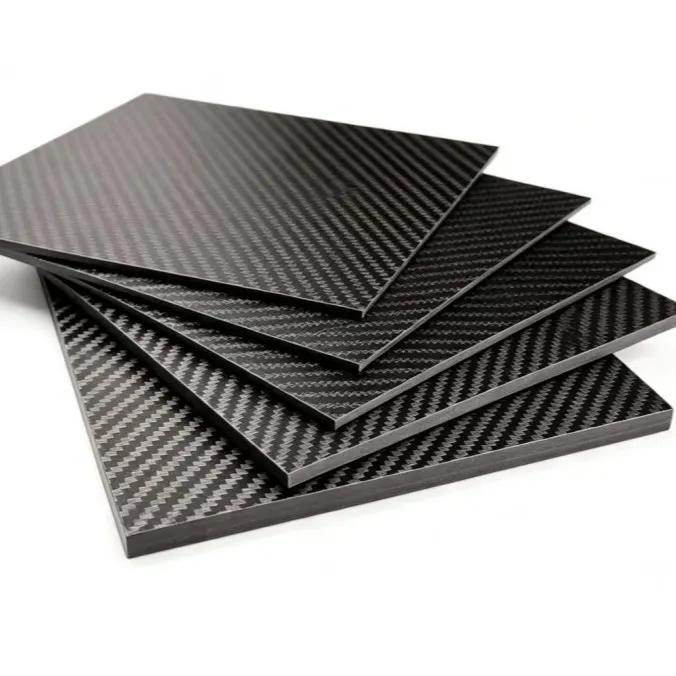
Two reasons drive almost every carbon fiber auto part: weight and appearance. At equal stiffness, a carbon fiber panel is roughly half the weight of steel and a third lighter than aluminum, which matters for unsprung mass, hood/trunk weight over the axles, and rotating or hinged parts. The second reason is purely visual — a clear-coated 3K twill weave reads as "performance" instantly, which is why so many parts (mirror caps, trim, engine covers) are cosmetic carbon with no weight agenda at all [1][2].
Aftermarket vs OEM vs Fully Custom — Which Do You Need?
These three words decide your price, lead time and tooling cost. Most buyers actually want "aftermarket" (a part made to fit a popular model from existing tooling) but ask for "custom" (a new part designed from scratch). Knowing the difference saves weeks and thousands in mold fees [3].
| Type | What it is | Tooling | Lead time | Best for |
|---|---|---|---|---|
| Aftermarket | Part for a popular model from an existing mold (we hold tooling for 100+ vehicles) | Already exists | 14–21 days | Common cars (BMW, Audi, Tesla, Mustang…) |
| OEM / private-label | Your brand, your spec, your drawings — we manufacture | You own the mold | 35–50 days first run | Brands building a product line |
| Fully custom | New part from your CAD or a 3D scan of a donor part | New mold required | 35–60 days | Rare cars, unique designs, prototypes |
The Most-Requested Custom Carbon Fiber Car Parts
Across thousands of orders, the demand concentrates on a predictable set of parts. Exterior parts are usually structural-cosmetic (they must fit and survive airflow); interior parts are almost always cosmetic.
- Exterior body: hoods, trunk/boot lids, roof panels, fenders, full body kits.
- Aero: front lips and splitters, side skirts, rear diffusers, spoilers and GT wings, canards.
- Trim & detail: mirror caps, door handle covers, B-pillar covers, fuel cap covers, badges.
- Interior: dashboard trim, center-console panels, paddle shifters, door cards, gauge surrounds.
- Carbon fiber steering wheels — one of the highest-margin custom requests, often with Alcantara and LED inserts.
Real Carbon vs Forged Carbon vs "Carbon Look"
This is where buyers overpay or get cheated most often. "Carbon fiber" on a listing can mean three completely different things [4].
| Construction | Look | Structural? | Typical use |
|---|---|---|---|
| Dry / prepreg woven (real) | Crisp 3K/12K twill weave | Yes — strongest | Hoods, structural panels, aero |
| Wet layup woven (real) | Twill weave, slightly heavier | Yes | Most aftermarket exterior parts |
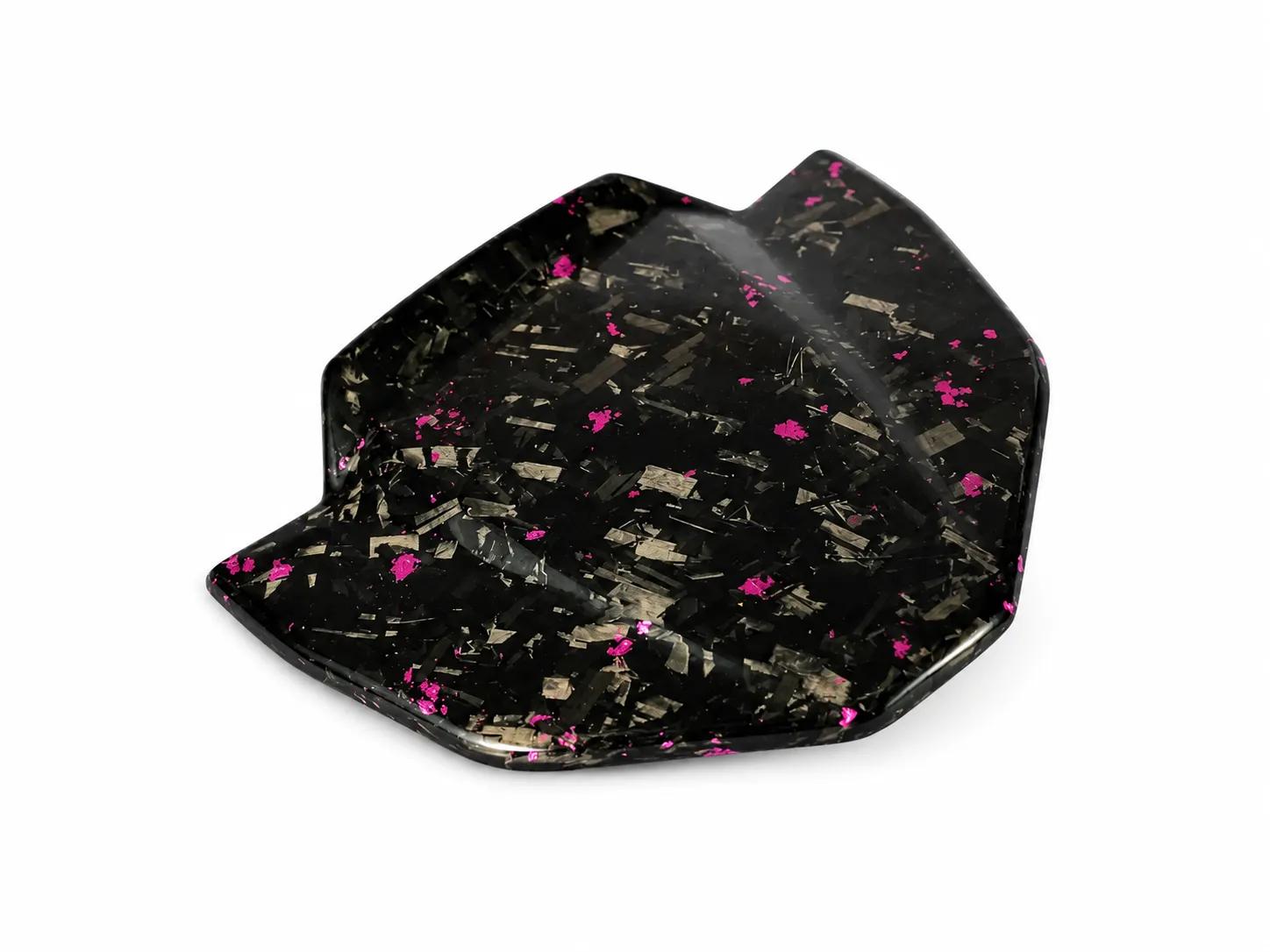
| Forged carbon (chopped fiber) | Marbled, no weave lines | Moderate | Trim, caps, premium cosmetic |
| Hydro-dip / "carbon look" | Printed pattern on plastic | No (it is plastic) | Budget cosmetic only — not real carbon |
How Custom Carbon Fiber Car Parts Are Made
Whether you supply CAD or we 3D-scan your OEM part, the path to a finished aftermarket panel follows the same gates.
- 1. CAD or 3D scanStart from your CAD, or we 3D-scan the donor OEM part (±0.1 mm) to capture exact mounting points.
- 2. Mold makingA CNC-machined master and fiberglass/epoxy or aluminum production mold is built to the scanned geometry.
- 3. LayupWoven prepreg or wet-layup carbon is laid into the mold with the weave aligned to the design and load path.
- 4. CureVacuum-bag or autoclave cure consolidates the laminate and removes voids.
- 5. Trim & fitCNC-trim edges and mounting holes; test-fit against the OEM hardpoints before finishing.
- 6. Clear coat2K automotive UV-stable clear coat (matte or gloss) for 5+ years of outdoor durability.
Cost & MOQ: What to Budget
The biggest cost driver is whether a mold already exists for your car. Aftermarket parts for popular models skip the tooling fee entirely; a fully custom part for a rare car pays for the mold once, then amortizes it over the run [5].
| Part | Existing mold? | MOQ | Indicative unit cost |
|---|---|---|---|
| Mirror caps (pair) | Often yes | 10–50 | $25–60 |
| Interior trim set | Sometimes | 20–100 | $60–180 |
| Spoiler / wing | Popular models yes | 5–30 | $90–280 |
| Hood / bonnet | Popular models yes | 1–20 | $300–650 |
| Full body kit | Popular models yes | 1–10 | $1,200–4,000 |
| New custom part (any) | No — new mold | 1+ (mold $1.5k–8k) | Quoted per geometry |
Quality, Fitment & UV — What to Check Before You Pay
- Fitment: confirm the part is built around real OEM mounting points (3D-scanned), not a "universal" approximation that needs grinding to fit.
- Clear coat: ask for a 2K automotive UV-stable clear coat. Cheap parts use a thin UV-cure coat that yellows within a year in sun.
- Weave alignment: the twill should run straight and symmetric across the part — wandering weave is the tell of a rushed layup.
- Structural vs cosmetic: a hood or splitter must be a proper laminate, not a thin cosmetic skin over foam. Ask for the ply schedule.
- Certification: for parts sold into regulated markets, request the resin/RoHS declaration and, for structural parts, basic test data.
Sourcing Factory-Direct: How to Order
You do not need engineering drawings to start. The three fastest routes into a quote:
- Name the part + car: e.g. "carbon fiber hood for a 2020 Mustang GT" — if we hold the mold, you skip tooling entirely.
- Send a photo or the donor part: we 3D-scan it and build matching tooling.
- Send CAD (STEP/Parasolid): fastest path for a brand with its own design.
For a brand building a product line, OEM/private-label production lets you put your own logo on parts produced to your spec, with the mold owned by you. Browse the Automotive Parts Manufacturer hub for current OEM lines, or use the custom page to start a new part.
Frequently Asked Questions
The questions our automotive sales engineers field most often.
Are aftermarket carbon fiber parts as strong as OEM steel or aluminum?
For cosmetic and aero parts, yes — a properly laid-up carbon panel matches or exceeds the stiffness of the OEM part at far lower weight. For safety-structural parts (crash structures, suspension), carbon must be specifically engineered and tested; do not assume a cosmetic supplier's panel is rated for structural loads.
Is forged carbon fiber stronger than woven carbon fiber?
No. Forged carbon (chopped fiber compression-molded) is a finish and process choice valued for its marbled look and ability to form complex shapes. Woven prepreg or wet-layup carbon is the right construction for load-bearing parts like hoods and splitters.
Can you make a custom carbon fiber part for a rare car you don't have a mold for?
Yes. Send the donor OEM part or a 3D scan and we build matching tooling, or work from your CAD. New tooling runs roughly $1,500–$8,000 depending on size and complexity, paid once and amortized over your run.
What is the MOQ for custom carbon fiber car parts?
CNC-cut flat parts and single molded prototypes can be ordered as one piece. For molded exterior parts, MOQ is typically 1–20 for popular models with existing tooling, and set by mold amortization for new custom parts.
How do I know the part will actually fit my car?
Fitment depends on whether the mold was 3D-scanned from a genuine OEM part. Always confirm this. Parts copied from copies are the main cause of gaps and misaligned mounting holes. We 3D-scan to ±0.1 mm against real OEM hardpoints.
Will the carbon fiber fade or yellow in the sun?
Only if it uses a cheap topcoat. Specify a 2K automotive UV-stable clear coat and the part holds its finish for 5+ years outdoors. Avoid parts finished with a thin UV-cure coat, which yellows within a year of sun exposure.
Can you produce carbon fiber car parts under my own brand (OEM/ODM)?
Yes. We offer private-label and OEM production: parts made to your spec and logo, with tooling you own and an NDA in place. MOQ and pricing scale with volume — contact us with your model list and target quantities for a quote.
Sources & Further Reading
- CompositesWorld — Carbon fiber in automotive applications
- SAE International — Composites in Automotive
- Toray Composite Materials — Automotive solutions
- Hexcel — Prepreg processing guide
- Wikipedia — Carbon-fiber-reinforced polymer
- Wikipedia — Forged composite
- IATF 16949 — Automotive quality management
- RoHS Directive 2011/65/EU
- ASTM D3039 — Tensile properties of composites
- PPG — 2K automotive clear coat technical overview
Need Custom Carbon Fiber Products?
Our engineering team helps brands worldwide develop OEM carbon fiber solutions with low MOQs and rapid prototyping.
Request a Quote Today.