Full Face vs Modular Carbon Fiber Helmets: Which Should You Buy?
Full-face or modular (flip-up) carbon fiber helmet? Compare weight, safety, noise, convenience and price — plus what ECE 22.06 P/J certification means and how to choose for touring, sport or commuting.
This technical guide was prepared by the MASTERMATE Engineering Team based on our experience in carbon fiber material selection, composite manufacturing, CNC machining and OEM/ODM production.
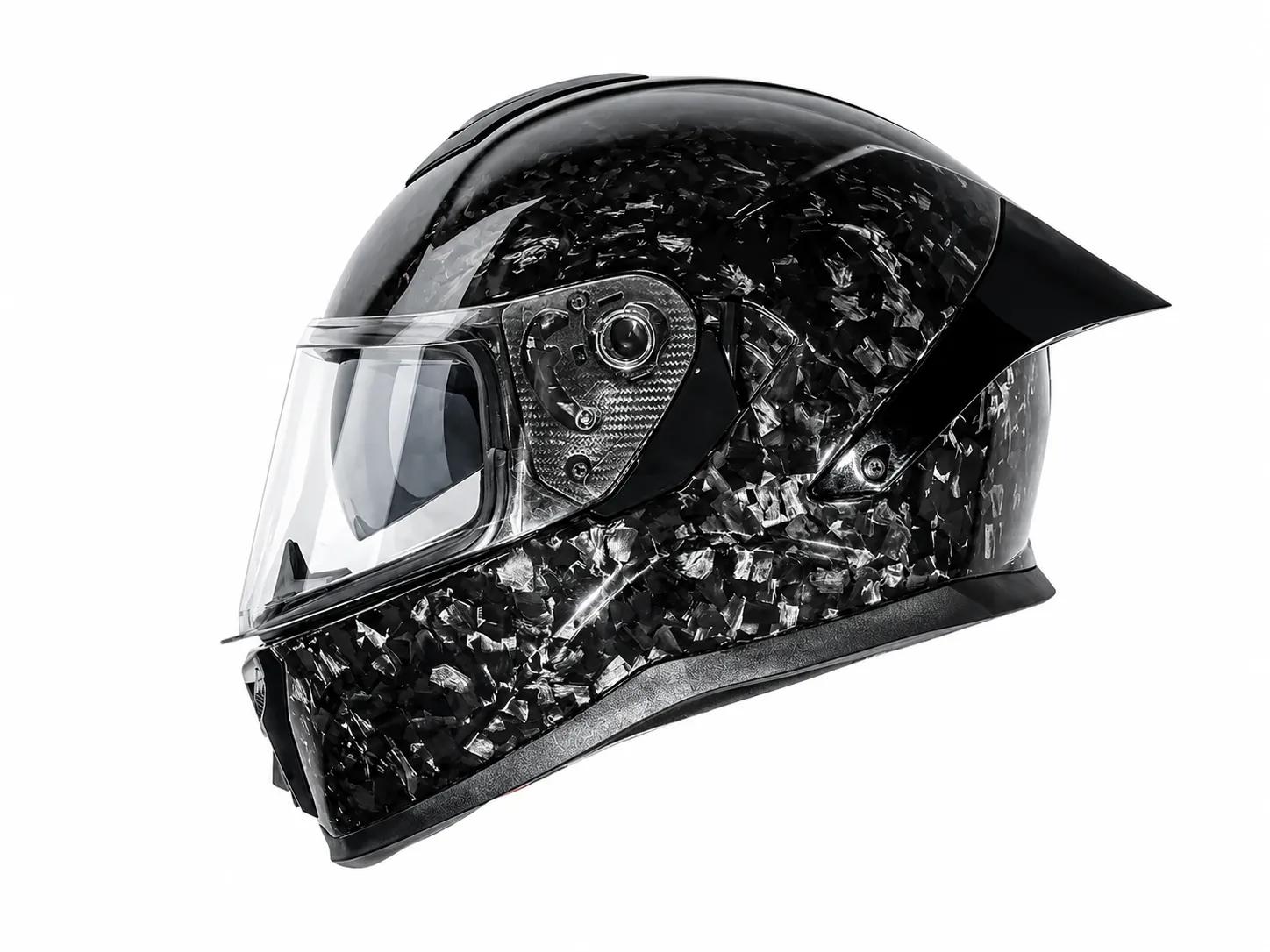
Once you have decided you want a carbon fiber motorcycle helmet, the next fork is shape: full-face or modular (flip-up). It is the single most consequential choice you make — it changes the helmet's weight, noise, protection and how you actually live with it day to day. Carbon fiber is available in both, and the weight advantage of carbon plays out differently in each. This guide is the head-to-head we walk buyers through before they pick a carbon shell.
The Core Difference: A Fixed vs Hinged Chin Bar
A full-face helmet is one continuous shell — the chin bar is part of the structure. A modular (also called flip-up) helmet has a chin bar on a hinge that rotates up and out of the way. Everything else about the comparison flows from that single mechanical difference [1].
- Full-face: fixed chin bar, one-piece shell, no hinge — lightest and structurally simplest.
- Modular: hinged chin bar + locking mechanism, so you can open the front without taking the helmet off.
- Both are offered in full carbon fiber, carbon hybrid, and "carbon look" — the same construction caveats from any carbon helmet apply.
Full-Face vs Modular: Head-to-Head
Here is how the two compare across the things riders actually feel. Carbon shells narrow the weight gap but do not erase it — the hinge hardware on a modular is steel and plastic, not carbon.
| Factor | Full-Face Carbon | Modular Carbon |
|---|---|---|
| Weight (size M) | ~1,150–1,400 g | ~1,450–1,750 g |
| Noise | Quietest | Slightly louder (hinge seams) |
| Protection | Highest, fixed chin bar | High if ECE 22.06 P-rated |
| Convenience | Must remove to talk/drink | Flip up without removing |
| Best for | Sport, track, performance | Touring, commuting, glasses |
| Typical price | Lower for equal quality | Higher (mechanism cost) |
The P/J Rating: The One Thing to Check on a Modular
This is the detail that separates a safe modular from a risky one. Under ECE 22.06, modular helmets carry a P and/or J marking that tells you how the helmet was tested and certified [2][3].
| Marking | Meaning | Safe to ride chin-down? |
|---|---|---|
| P | Protective — tested with chin bar locked closed | Yes — full chin protection |
| J | Jet — tested only as an open-face | No — not rated chin-down |
| P/J | Certified both closed (P) and open (J) | Yes when closed; legal open at low speed |
Why Carbon Matters More on a Modular
A modular helmet starts heavier than a full-face because of the hinge, lock and the extra shell cutline. That is exactly why carbon is so popular on modulars: trimming 300–400 g off an already-heavy touring lid is the difference between comfortable all-day riding and neck fatigue. On a full-face, carbon makes a light helmet lighter; on a modular, carbon makes a heavy helmet tolerable [4].
Which Should You Buy?
- Sport / track ridingFull-face carbon. Lowest weight, best aero and noise, fixed chin bar — no reason to add a hinge.
- Touring / long distanceModular carbon (P or P/J). Flip up at fuel stops and toll booths; carbon offsets the hinge weight.
- Daily commutingModular carbon if you stop often or wear glasses; full-face if your priority is weight and quiet.
- Glasses wearersModular — flip the front up to put glasses on and down over them, no fishing under the chin bar.
- Maximum protectionFull-face. A one-piece carbon shell with a fixed chin bar is the strongest configuration.
Sourcing & Custom Carbon Helmets (Both Types)
Whether you want full-face, modular or a mix across a product line, factory-direct carbon helmets come certified to your market (ECE 22.06 for Europe, DOT for the US). For brands, both shapes support custom graphics and private-label production on a certified base shell.
- Pick the shape(s) + certification: e.g. "modular carbon, ECE 22.06 P/J, sizes S–XXL".
- Send graphics / brand kit: we apply paint, liners and packaging to a certified base shell.
- For a new shell design: send references or CAD; we build and certify tooling to your market.
Browse the Carbon Fiber Helmet Manufacturer hub for full-face and modular OEM programs, or use the custom page to start a branded run. Related reading: our complete carbon fiber motorcycle helmet buyer's guide covers weight, certification and real-vs-forged in depth.
Frequently Asked Questions
The questions our helmet sales engineers hear most when buyers choose between the two.
Are modular (flip-up) carbon helmets as safe as full-face?
A modular certified ECE 22.06 "P" or "P/J" is tested for chin-bar impact with the front locked closed and offers protection close to a full-face. A modular marked "J only" is certified only as an open-face and does not have rated chin protection. A full-face has a fixed chin bar and is always the structurally strongest configuration, but a P-rated modular is a legitimately safe touring choice.
How much heavier is a modular carbon helmet than a full-face?
Typically 250–400 g. A carbon full-face is around 1,150–1,400 g in size M; a carbon modular is around 1,450–1,750 g because of the hinge, lock and extra shell cutline. Carbon construction is especially valuable on modulars precisely because it offsets that hinge weight.
What does P/J mean on a modular helmet?
Under ECE 22.06, "P" means the helmet passed chin-bar impact testing locked closed (protective), and "J" means it passed open-face (jet) testing. A "P/J" helmet is certified for both — protective when closed and legal to ride open at low speed. Buy P or P/J, never J-only, if you want chin protection.
Can you ride a modular helmet with the chin bar up?
Only if it is J or P/J certified, and only at low speed — riding open-face offers no chin protection. The flip-up function is designed mainly for stops (fuel, tolls, conversations), not for riding at speed. Always ride with the chin bar locked down for full protection.
Which is better for touring, full-face or modular carbon?
Most touring riders prefer a modular carbon helmet (P/J rated): you can flip it up at stops without removing it, and carbon offsets the hinge weight for all-day comfort. Choose a full-face if you prioritise the lowest weight and quietest ride over convenience.
Can you produce both full-face and modular carbon helmets under my brand?
Yes. We offer custom-graphic and private-label production on certified carbon shells in both shapes, to DOT or ECE 22.06 (P/J for modulars). MOQ is typically 50–100 for custom graphics and 100–300 for full private-label. Send your model list, target market and graphics for a quote.
Sources & Further Reading
Need Custom Carbon Fiber Products?
Our engineering team helps brands worldwide develop OEM carbon fiber solutions with low MOQs and rapid prototyping.
Request a Quote Today.