Carbon Fiber Dirt Bike, Motocross & Racing Helmets: Off-Road & Track Guide
Carbon fiber helmets for dirt bike, motocross and racing — why off-road and track riders choose carbon, how MX helmets differ from street, SNELL/FIM racing certification, and what forged carbon adds.
This technical guide was prepared by the MASTERMATE Engineering Team based on our experience in carbon fiber material selection, composite manufacturing, CNC machining and OEM/ODM production.
On the road a carbon helmet is a comfort upgrade; off-road and on track it is closer to a necessity. Motocross is one of the most physically demanding motorsports, and road racing means hours at speed with high head loads — both punish helmet weight directly. Carbon fiber dirt bike, motocross and racing helmets exist because shedding 300–400 g off an actively working head is felt on every lap. This guide explains how these helmets differ from street carbon, what certification matters, and how to source them.
Why Carbon Off-Road and on Track
The case for carbon gets stronger the harder you ride. A motocross rider's head moves constantly under hard acceleration, jumps and ruts; a road racer holds a tucked position at speed with aero loads on the helmet. In both, lower weight means less neck fatigue, faster head movement, and less strain in a crash [1].
How Off-Road (MX) Helmets Differ from Street
A motocross helmet is not just a street helmet with graphics — its whole geometry is built for exertion, goggles and roost. The differences are deliberate [2].
| Feature | MX / off-road | Street full-face |
|---|---|---|
| Chin bar | Extended — easier breathing under load | Closer to face |
| Peak / visor | Sun peak (deflects roost & sun) | No peak; internal flip visor |
| Eye protection | Goggles (open eyeport) | Built-in face shield |
| Ventilation | Maximal — heavy exertion | Moderate, aero-biased |
| Use | Dirt, MX, enduro, ADV | Road, sport, touring |
Racing Helmets: SNELL, FIM & Track Features
If you ride on a closed circuit in organized events, the certification bar rises. Track-day and racing carbon helmets carry standards beyond the road minimum, plus features built for crashes at speed [3][4].
- SNELL M2025: a stringent voluntary standard widely required for track days and club racing.
- FIM homologation: required for many professional road-racing series (a separate, race-specific approval).
- Emergency-release cheek pads: pull-tabs let marshals remove pads to extract a rider with less neck movement.
- Aero shaping & stabilisers: reduce lift and buffeting in a tuck at high speed.
- Wide eyeport: visibility in a racing crouch.
What Forged Carbon Adds
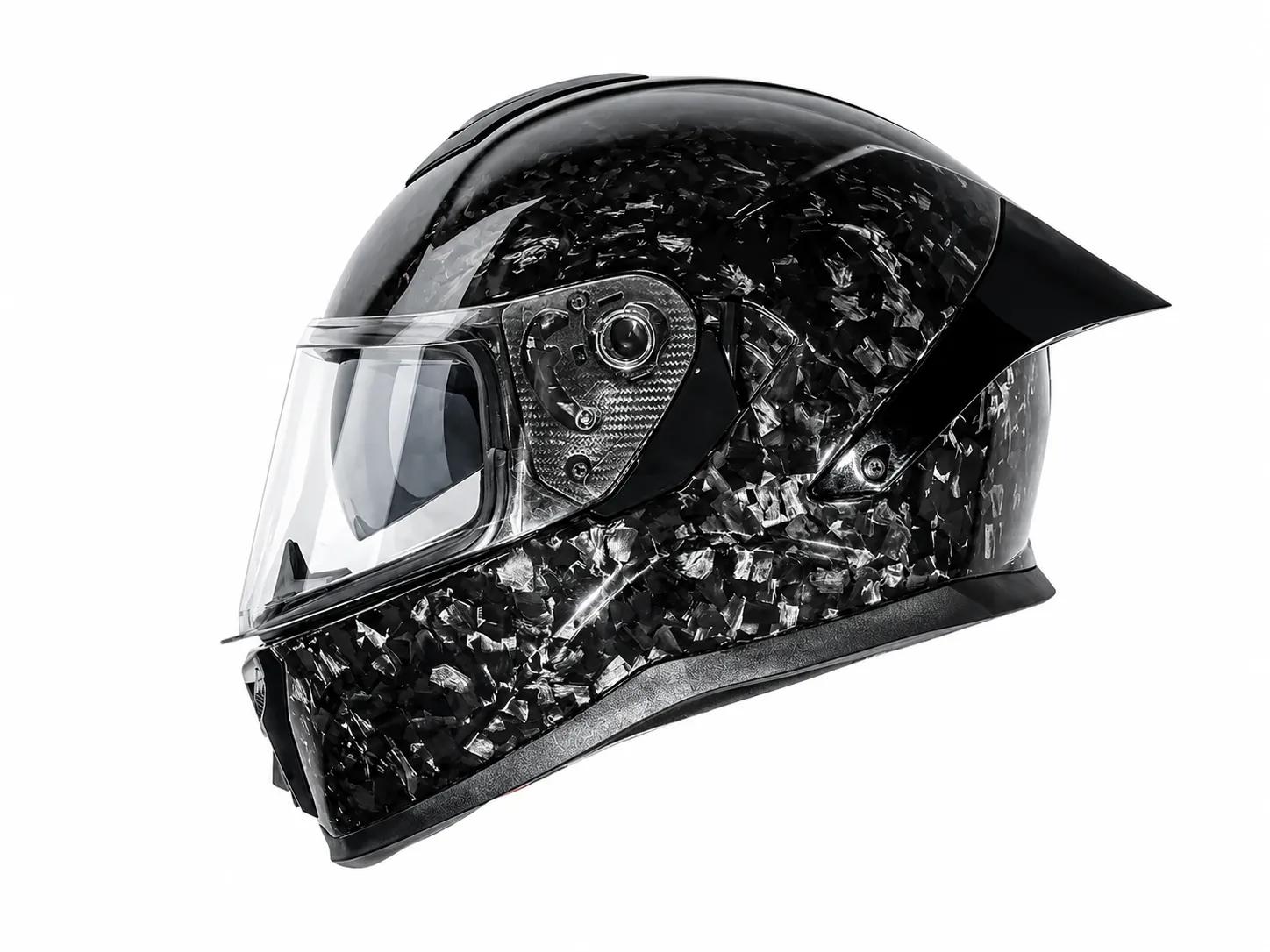
Forged carbon — chopped fiber compression-molded rather than woven — is increasingly used on premium off-road and racing helmets. It is not "stronger than woven"; it is a construction and finish choice prized for its marbled look and its ability to form the complex vented, peaked shapes these helmets need [5].
| Construction | Look | Best for | Note |
|---|---|---|---|
| Woven prepreg | Classic 3K/12K twill | All shells; structural areas | The standard high-performance shell |
| Forged carbon | Marbled, no weave lines | Complex vented/peaked shapes, accents | Premium look; forms complex geometry |
| Hybrid (carbon + aramid) | Carbon outer | Impact zones | Tunes impact behaviour |
Choosing the Right Performance Helmet
- Pure motocross / dirtMX carbon shell: extended chin, peak, max vents, goggle eyeport. Lightest for moto fatigue.
- Enduro / dual-sport / ADVADV carbon: peak + face shield + goggle-ready. One helmet for road and trail.
- Track days / club racingSNELL M2025 carbon full-face with emergency-release pads and aero shaping.
- Pro road racingFIM-homologated carbon to the series rulebook; confirm the accepted list.
- Premium buildForged carbon for the marbled look and complex vented geometry, on any of the above.
Sourcing Off-Road & Racing Carbon Helmets
Whether you buy one helmet or build a performance line, factory-direct carbon helmets come certified to your discipline and market. For brands, MX, ADV and racing shells all support custom graphics and private-label production.
- State the discipline + certification: e.g. "MX carbon, ECE 22.06, size range" or "track full-face, SNELL M2025".
- Send graphics / brand kit: we apply custom paint and liners to a certified base shell.
- For forged-carbon or a new shell: send references; we build and certify tooling.
Browse the Carbon Fiber Helmet Manufacturer hub for motorcycle and racing OEM shells, or use the custom page for branded production. Related reading: the complete carbon fiber motorcycle helmet guide, full-face vs modular, and how to choose the best carbon helmet.
Frequently Asked Questions
The questions off-road and track riders ask most.
Why are motocross helmets shaped differently from street helmets?
A motocross helmet has an extended chin bar (easier breathing under hard exertion), a sun peak (deflects roost and sun), an open eyeport for goggles instead of a built-in face shield, and maximal ventilation. The geometry is built for the physical demands of off-road riding rather than highway aerodynamics. Carbon construction keeps these vented shells light.
What certification do I need for a racing carbon helmet?
It depends on the series. Track days and club racing often require SNELL M2025; many professional road-racing series require FIM homologation; ECE 22.06 is the European road standard. Always check the specific rulebook of the events you enter — organisers specify exactly which standard and homologation list they accept at tech inspection.
Is forged carbon better than woven carbon for off-road helmets?
Neither is "better" for protection — both are real carbon and protection comes from certification. Forged carbon (chopped fiber, compression-molded) is valued for its marbled look and its ability to form the complex vented, peaked shapes off-road and racing helmets need. Woven prepreg remains the standard structural construction. Choose by appearance and shape complexity.
Can I use a dirt bike carbon helmet on the road?
A pure MX helmet has no face shield (you wear goggles) and an open, peaked design optimised for off-road — it is legal on the road if certified (DOT/ECE) but noisy and less aero at highway speed. For mixed use, an ADV/dual-sport carbon helmet with both a peak and a face shield is the better one-helmet solution.
How much weight does carbon save on a motocross helmet?
Typically 300–400 g versus a comparable polymer or composite MX shell — a carbon vented MX helmet is around 1,150–1,350 g versus 1,500–1,700 g. Because motocross is physically intense and motos are long, that saving translates directly into less neck fatigue over a race.
Can you produce off-road and racing carbon helmets for my brand?
Yes. We make certified carbon MX, ADV and racing shells and offer custom-graphic and private-label production, including forged carbon, to DOT / ECE 22.06 / SNELL as required. MOQ is typically 50–100 for custom graphics and 100–300 for full private-label. Send your discipline, target market and graphics for a quote.
Sources & Further Reading
Need Custom Carbon Fiber Products?
Our engineering team helps brands worldwide develop OEM carbon fiber solutions with low MOQs and rapid prototyping.
Request a Quote Today.