Carbon Fiber Laminate Design: Fiber Orientation, Stiffness and Layup
How 0°, 90° and ±45° fiber orientation changes carbon fiber laminate stiffness, and what to put on a drawing before you request a custom plate or part.
This note is the laminate briefing MASTERMATE uses when a buyer sends a plate or custom-part drawing. It is design guidance, not a tested stiffness for any specific plate.
Buyers who only need a stock plate can start with the sheets and plates guide. This article is the next step: how fiber orientation changes stiffness, and what a factory needs before it quotes a structural laminate. For geometry, holes and draft angles, use the custom-part design guide.
1. Unidirectional tape and woven cloth do different jobs
Unidirectional (UD) material puts nearly all fibers in one direction. Along those fibers it is stiff and strong; across them it relies on the resin and is comparatively weak. Woven cloth crosses fiber tows, so one ply already has fibers in two directions, but the crimp where tows pass over each other lowers the in-axis stiffness compared with straight UD tape of the same fiber [1][2].
| Form | Best used for | Watch-out |
|---|---|---|
| UD tape | A known primary load direction | Very weak across the fiber unless other plies cover that axis |
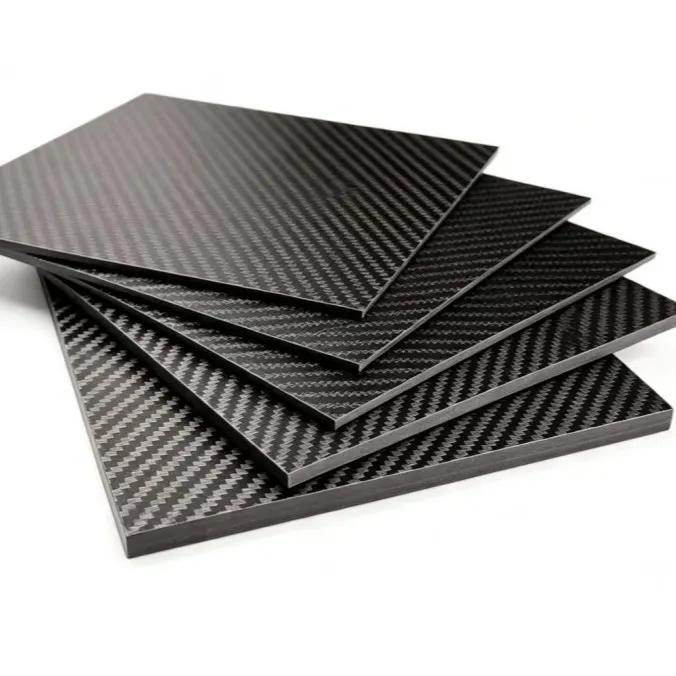
| Woven cloth | Plates that need fibers in two directions in each ply, and a visible weave | Crimp and a larger minimum bend radius than straight fiber |
| Quasi-isotropic stack | Loads that can arrive from more than one in-plane direction | Heavier than a UD stack designed for one load |
2. Use 0°, 90° and ±45° on purpose
Classical laminate theory treats each ply as stiff along its fiber and compliant across it, then adds the plies through the thickness [1]. In shop language:
- 0° plies carry axial tension and compression along the long axis you define on the drawing.
- 90° plies carry the in-plane load across that axis.
- ±45° pairs carry shear. One +45° ply without a −45° ply creates twist coupling.
- A balanced laminate has matching +θ and −θ plies. A symmetric laminate mirrors the stack about the midplane, which drives the bend–extension coupling terms toward zero [1].
- A common starting schedule, [0/±45/90]s, is often called quasi-isotropic in the plane. Bending stiffness still depends on which plies sit on the outside.
3. Keep datasheet numbers and laminate tests apart
A fiber or prepreg datasheet publishes values for that product under its own test method. A finished plate also depends on ply angles, fiber volume, voids, cure and the direction of the test. ASTM D3039 is a tensile method for polymer-matrix composites; ASTM D7264 is a flexure method. They are not interchangeable, and neither number is a strength you can advertise for every plate thickness [3][4]. CMH-17 is the place to read how allowables are built from test data rather than from a single brochure cell [2].
MASTERMATE can laminate and cut carbon fiber plate. This article does not publish a factory modulus, strength or fiber-volume result. If a program needs an allowable, agree the test method, specimen direction and laminate schedule before production.
4. Put this on the drawing or in the RFQ
- Reference axis: which edge is 0°.
- Ply schedule and material form (UD or weave), or the stiffness directions you need if the factory may propose the schedule.
- Finished thickness and the tolerance that actually matters.
- Fiber family and resin system if they are constrained; otherwise say “factory selection, subject to approval.”
- Load case in one sentence: tension, bending, shear, or a combination, and the environment if it is not room temperature and dry.
- Whether the part must stay flat after cure. That is a symmetry and process question, not a weave-photo question.
Send that package through custom carbon fiber parts. Stock plate formats are listed on the carbon fiber plate page; a structural schedule can still differ from that stock layup. If the next operation is machining, read CNC design rules for holes and edges before you freeze hole positions.
Does a 3K twill surface tell me the laminate is quasi-isotropic?
No. Twill describes the visible weave. Quasi-isotropic describes the ply-angle schedule through the thickness. Ask for the schedule or for the stiffness directions the plate was built to meet [1].
Will a symmetric laminate always cure flat?
Symmetry removes a major source of extension–bend coupling [1]. Tooling, cure pressure, resin flow and uneven cooling can still warp a plate. Flatness has to be agreed as a measured requirement.
Can I use the fiber tensile modulus as the plate bending modulus?
No. Bending stiffness depends on which plies are farthest from the midplane, and flexure tests such as ASTM D7264 are not the same as a fiber datasheet tensile test [1][4].
Sources & Further Reading
- [1] NASA RP-1351 — Basic Mechanics of Laminated Composite Plates (classical laminate theory, coupling, bending)
- [2] CMH-17 — Composite Materials Handbook (allowables and laminate data, not a single-point brochure value)
- [3] ASTM D3039/D3039M — tensile properties of polymer matrix composite materials
- [4] ASTM D7264/D7264M — flexural properties of polymer matrix composite materials
How This Guide Was Prepared
Orientation effects follow classical laminate theory as summarized in NASA RP-1351 and CMH-17. No modulus, strength or thickness in this article is a MASTERMATE test result. Fiber producer datasheets describe the fiber or prepreg, not a finished multi-angle laminate, unless the datasheet says so.
Need Custom Carbon Fiber Products?
Our engineering team helps brands worldwide develop OEM carbon fiber solutions with low MOQs and rapid prototyping.
Request a Quote Today.